A hurt back or a torn shoulder can settle for very different amounts, starting with how the injury happened, which determines whether it’s a comp claim, a civil claim, or both. There is no single reliable "California average" for either injury. Value depends mainly on claim type, injury severity, treatment, liability, insurance coverage, and the losses you can document, not one statewide number.
At Ochoa & Calderón, our Riverside back and neck injury lawyers have handled these settlements from both sides of the aisle, so we can evaluate the workers' comp and civil sides of a claim separately and know how the insurance companies think and what they’ll do next.
Workers' Comp or Personal Injury: Which Path Applies
If an industrial accident caused the injury, the claim runs through California workers' compensation. There, back injuries commonly settle between $5,000 and $200,000+, and shoulder injuries between $15,000 and $195,000+.
If someone else's negligence caused it, such as a car crash or a fall on unsafe property, a personal injury claim may apply instead. Back injuries in these civil cases can range from $10,000 to $700,000+, and shoulder injuries can range from $31,000 to $625,000+, because a civil claim also pays for pain and suffering, loss of life’s pleasures, and loss of consortium, all of which workers' comp does not.
These ranges blend back and shoulder settlements into one severity scale, since severity drives the number more than which body part was hurt; a knee or wrist claim follows the same pattern by injury severity, just in its own dollar range. Understand, though, that these ranges are general California figures, meant as context for the kinds of facts that move a number up or down, not a projection of what your case will bring. Your result depends on your medical record, fault, and available coverage. Past results do not predict future outcomes.
When a Claim Splits Into Two
Some injuries open both paths. If you were hurt driving for work, riding in an Uber or Lyft, or struck by a commercial truck while on the clock, you may be able to file a workers' comp claim and a separate personal injury claim against the at-fault third party.
The comp claim covers medical care and wage loss right away; the civil claim can pursue pain and suffering and full lost earnings. California requires rideshare companies to carry $1 million in liability coverage from the moment a driver accepts a ride until the trip ends. When the rideshare driver is at fault, a back or shoulder injury that would settle modestly in comp alone can be worth substantially more against that policy. If an uninsured or underinsured third-party driver caused the crash instead, the rideshare’s uninsured-motorist coverage is now much lower: $60,000 per person since January 1, 2026.
What Actually Moves the Number
Value tracks the medicine. Two things move a settlement more than anything else: how invasive the treatment was, and whether objective imaging backs up the pain. A settlement built on an MRI, a surgical report, and a clean timeline is harder for an adjuster to discount than one built on complaints alone.
That timeline is where quick medical care matters. Getting care soon after the injury, often discussed as a 48-hour window, can make it easier to document that the pain traces to the accident rather than to ordinary wear and tear. A gap of weeks gives the other side an opening to claim the real cause was age or a prior condition, not the crash or the fall. Prompt care helps counter that argument, and knowing your treatment rights and authorization process from the start protects the record you'll need later.
Back Injury Settlement Ranges
- Soft-tissue strains that heal with therapy: Roughly $10,000 to $40,000 in personal injury and roughly $5,000 to $20,000 in workers' comp.
- Herniated discs treated with epidural steroid injections (ESI) or radiofrequency ablation (RFA): Roughly $50,000 to $250,000 in personal injury, $20,000 to $60,000 in workers’ comp.
- Spinal fusion (surgically joining vertebrae): Roughly $200,000 to $700,000+ in personal injury, $75,000 to $200,000+ in workers’ comp.
Injections do more than treat pain. When a doctor puts a needle in the spine, that procedure becomes recorded medical evidence of a physical injury, which is one reason claims with a recorded ESI tend to settle higher, and surgery generally increases a settlement's value more broadly.
Shoulder Injury Settlement Ranges
The biomechanics of a crash put real force through the shoulder joint. When a seat belt locks during a collision, it can drive that force straight through the joint, a frequent cause of rotator cuff and labral (SLAP) tears.
- Non-surgical tears managed with therapy: Roughly $31,000 to $88,000 in personal injury, $15,000 to $45,000 in workers' comp.
- Arthroscopic repair (keyhole surgery on the cuff or labrum): Roughly $88,000 to $250,000 in personal injury, $40,000 to $90,000 in workers’ comp.
- Shoulder replacement: Roughly $225,000 to $625,000+ in personal injury, $150,000 to $195,000+ in workers’ comp.
When the injured shoulder is the dominant arm, settlement value often runs higher, since the disability affects daily life and earning capacity more directly. How much higher depends on the same facts driving every case: documented severity, treatment, and lost function, not a fixed formula, as the same pattern that shows up in arthroscopic knee surgery settlements.
What You Actually Keep: Gross Settlement vs. Net Payout
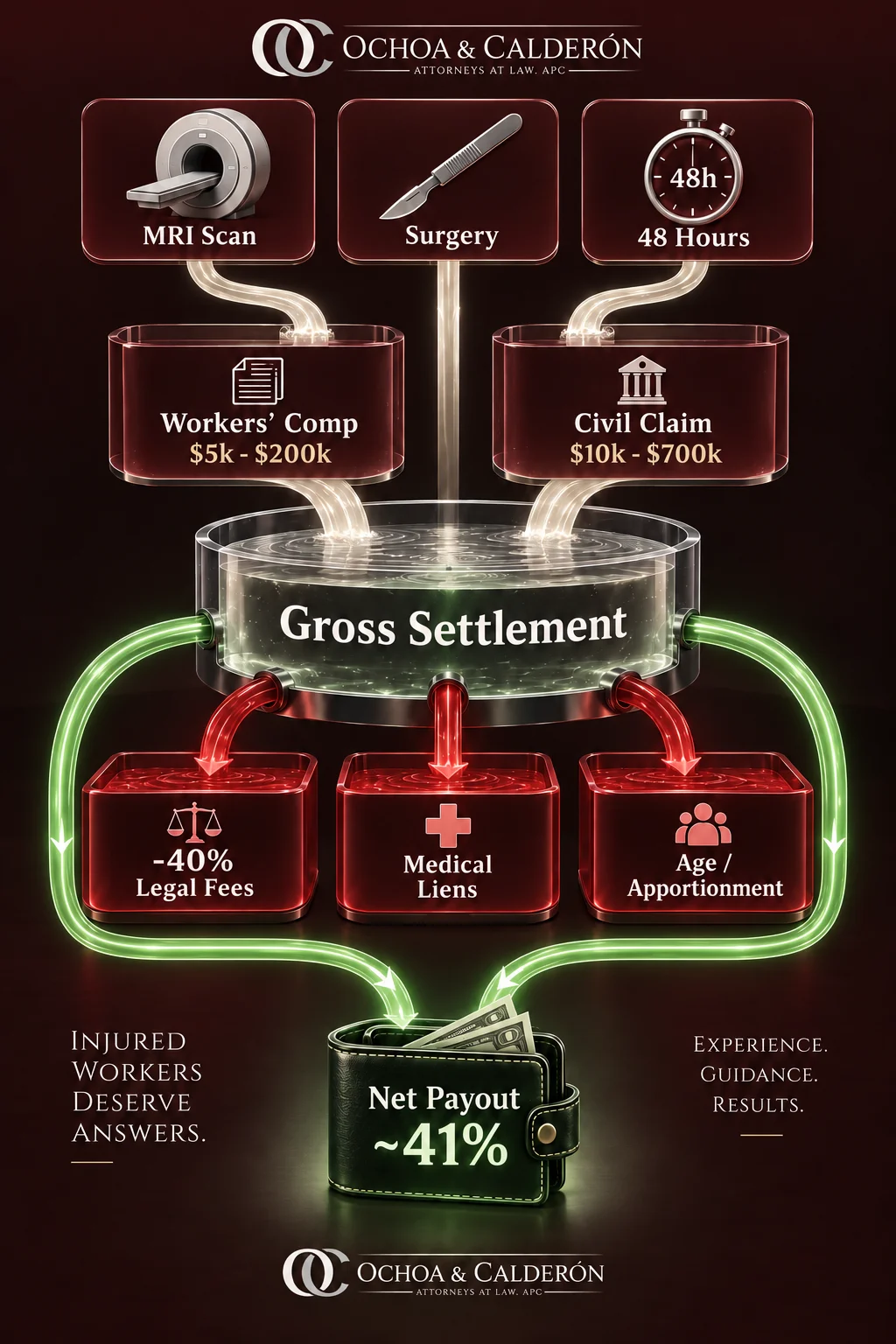
The number on a settlement check isn't the number that reaches a bank account, and it isn't the same question when that money actually arrives. Between the gross figure and the deposit sits a series of deductions that surprises almost everyone. Here is how a typical $125,000 personal injury settlement can break down:
A little over 40 percent. That math is why the lien line matters as much as the fee line.
Hospitals and health plans place liens on a settlement, a legal right to be repaid out of the money recovered. Left alone, those liens can take a large share. Negotiating them down is part of the work, and a reduced lien often puts more in a client's pocket than the fee takes out. A firm that trims a $30,000 lien to $18,750 has already offset a meaningful part of its own fee, a detail that simple "why pay 40 percent" math tends to miss.
This example is a personal injury settlement. Workers’ comp fees work differently: the Workers’ Compensation Appeals Board must approve them, and they are typically a much smaller percentage of the award.
To put it all into perspective, the journey of a claim isn't just about the deductions at the end. Here is the complete visual pipeline showing how a claim's value is built from initial medical evidence, routed through the comp or civil system, and ultimately distilled into your net payout:

Legal Rules That Shape Your Claim's Value
A handful of rules quietly shape how much a claim, whether comp or civil, ends up being worth:
- Howell v. Hamilton Meats & Provisions (2011): In a civil case, recovery for past medical bills is generally limited to what was actually paid or owed, not the amount originally billed.
- SB 1107 (30/60/15): California raised minimum auto liability limits to $30,000 per person / $60,000 per accident / $15,000 property for policies issued or renewed on or after January 1, 2025, more coverage to reach than the old floor.
- Eggshell Plaintiff Rule: A common-law principle reflected in California’s civil jury instructions (CACI 3927 and 3928): an at-fault party takes the injured person as they find them. If a crash aggravated a pre-existing degenerative disc, the at-fault party can still owe for that flare-up. An adjuster waving off a claim as "just arthritis" is not the end of the conversation.
- Proposition 213: An uninsured vehicle owner or driver generally can’t recover pain and suffering damages, even when the other side caused the crash, though medical bills and lost wages remain recoverable. A narrow exception applies when the at-fault driver is convicted of DUI.
- Workers' Comp Exclusivity: If a workplace accident caused the injury, Labor Code § 3602 generally makes workers’ comp your only claim against your own employer. It doesn’t bar a civil claim against someone else, such as a negligent driver or the maker of a defective machine (Labor Code § 3852). Keep in mind that the comp insurer can usually seek reimbursement or a credit from that civil recovery, so the two claims aren’t simply added together.
Workers' Comp: A Few Things Carriers Know That Injured Workers Often Don't

- Credits can zero out a check. Permanent disability payments already advanced during the case get subtracted from the final award. A 16% rating paid at the $290 maximum works out to about $16,000, and it can arrive as $0 if advances already covered it. That’s not an error, just how the math works, and it’s worth planning around.
- Apportionment can trim the rating. A Qualified Medical Evaluator (QME) can attribute part of an injury to pre-existing or age-related conditions under Labor Code § 4663, which can reduce a payout by 20% to 50%. The industrial-acceleration doctrine counters this when work sped up or worsened the condition, and a prompt, well-documented timeline supports that argument.
- Weekly disability pay is capped. For injuries since 2014, permanent partial disability pays at most $290 a week, a figure set by statute that doesn’t rise with the State Average Weekly Wage the way temporary disability does. If comp benefits are denied or delayed, EDD State Disability Insurance (SDI) may pay in the meantime. EDD then files a lien to recover those payments from the comp settlement. Disputes over comp benefits go to the Workers’ Compensation Appeals Board.
- Return-to-work benefits often go unused. If your injury left you unable to return to your old job, you may receive a Supplemental Job Displacement Benefit (SJDB) voucher worth $6,000 for retraining (Labor Code § 4658.7). That voucher also makes you eligible to apply to the state’s Return-to-Work Supplement Program (RTWSP) for a separate one-time $5,000 payment. The RTWSP application must be filed within one year of receiving the voucher.
Deadlines Worth Watching
Missing a date can end an otherwise strong claim, regardless of severity:
- 2 years to file a personal injury lawsuit (CCP § 335.1);
- 1 year to file a workers' comp claim (Labor Code § 5405);
- 90 days for your employer or its insurer to deny a claim after you file the claim form. If they don’t deny it in time, the injury is presumed compensable, and that presumption is hard to overcome.
A wrongful denial doesn't end your case; it starts a different clock, and you have the right to appeal. A few less common situations, including reopening a comp case, occupational disease or cumulative trauma claims, and claims against a government entity, run on separate clocks. Those are worth a direct conversation rather than a general rule of thumb.
FAQ: Back and Shoulder Injury Settlements in California
What is the average back injury settlement in California workers' comp?
There's no single average. Soft-tissue strains that heal with therapy tend to settle around $5,000–$20,000, while a spinal fusion can reach $75,000 to $200,000+. The severity rating a doctor assigns, more than any statewide number, sets the value.
Do shoulder injuries settle for more than back injuries?
Not automatically. Value tracks severity and treatment more than which body part was hurt, although non-surgical shoulder tears tend to run somewhat higher than simple back strains. At the top end, a shoulder replacement and a spinal fusion both reach well into six figures.
How much of a settlement do you actually keep after fees and liens?
On a typical $125,000 personal injury settlement, after a 40% attorney fee, case costs, and negotiated medical liens, a client often keeps a little over 40 percent of the gross amount. Negotiating the liens down is usually what protects that number most.
Can you file both a workers' comp and a personal injury claim for the same injury?
Sometimes. If a work accident also involved a negligent third party, a defective piece of equipment, or a driver in a work-related crash, you may be able to pursue a workers' comp claim and a separate personal injury claim at the same time.
Get a Free Second Opinion on Your Settlement Offer
If you already have an offer in hand, a second read on the numbers before you sign costs nothing and carries no pressure. Request a free case review.
Get a Clear, Honest Assessment of Your Claim
A back or shoulder injury settles very differently depending on the claim type, the medicine behind it, and who is doing the math on the deductions. You don't have to accept an insurer's first number, and you don't have to guess whether it reflects the full picture.
If there's already an offer on the table, don't sign it without a second look. Ochoa & Calderón has spent years pushing back against insurance companies that lowball back and shoulder claims, and reviews your offer, the liens, and the deadlines from its Riverside office, serving Upland and the rest of the Inland Empire. No fee unless we recover for you.
Call us today at (951) 901-4444 (Riverside) or (844) 991-6675 (Upland and surrounding areas) to schedule a free case review, or reach out online.

Co-Founder & Partner
Co-founder bringing elite education from Pacific Union College and Chapman Law to every case.