Dress codes often appear neutral, but in practice, they can shape who feels respected, who is disciplined, and who is quietly pushed out. Our Riverside workplace discrimination lawyers at Ochoa & Calderón regularly assist employees facing discipline, lost opportunities, or daily pressure due to appearance rules that constitute dress code discrimination.
California law allows employers to regulate appearance, but only within firm legal boundaries. While employers may regulate appearance, California law strictly limits dress code policies that create unequal treatment based on sex, gender identity, or gender expression.
Are Workplace Dress Codes Allowed Under California Law
Yes — employers may impose dress and grooming standards to support safety, professionalism, or business image. These policies are evaluated primarily under the California Fair Employment and Housing Act (FEHA) and Title VII of the Civil Rights Act of 1964.
However, a policy that appears neutral on paper can still create unlawful dress code discrimination at work if it places heavier burdens on employees based on sex, gender identity, or gender expression. Courts tend to focus on how a rule operates in reality, not how it is described in an employee handbook.
Dress Code Rules That Most Often Cross the Legal Line
Some dress code requirements raise red flags because they consistently impose greater costs, discomfort, or risk on a particular group of employees. These rules are often justified as “professional standards,” but may still result in dress code gender discrimination.

Under the California Government Code § 12940(a), employers may not discriminate against employees based on sex, gender, gender identity, or gender expression. This includes appearance and grooming standards that place a heavier burden on women or reinforce traditional gender roles.
Common examples include:
- Requiring women to wear skirts, dresses, makeup, or heels while men are permitted functional attire;
- Enforcing grooming standards that demand daily styling or cosmetic maintenance from one gender;
- Mandating revealing, form-fitting, or sexualized clothing without a legitimate business purpose;
- Disciplining employees for appearance choices tied to gender stereotypes.
In addition, California law explicitly prohibits employers from requiring women to wear skirts or dresses instead of pants. Women must be allowed the option of pants where attire options exist, and denial of that choice can constitute unlawful sex discrimination. Dress code disputes often overlap with other forms of workplace discrimination, including sexual harassment or unequal treatment based on gender.
When Gender-Specific Dress Codes May Be Lawful
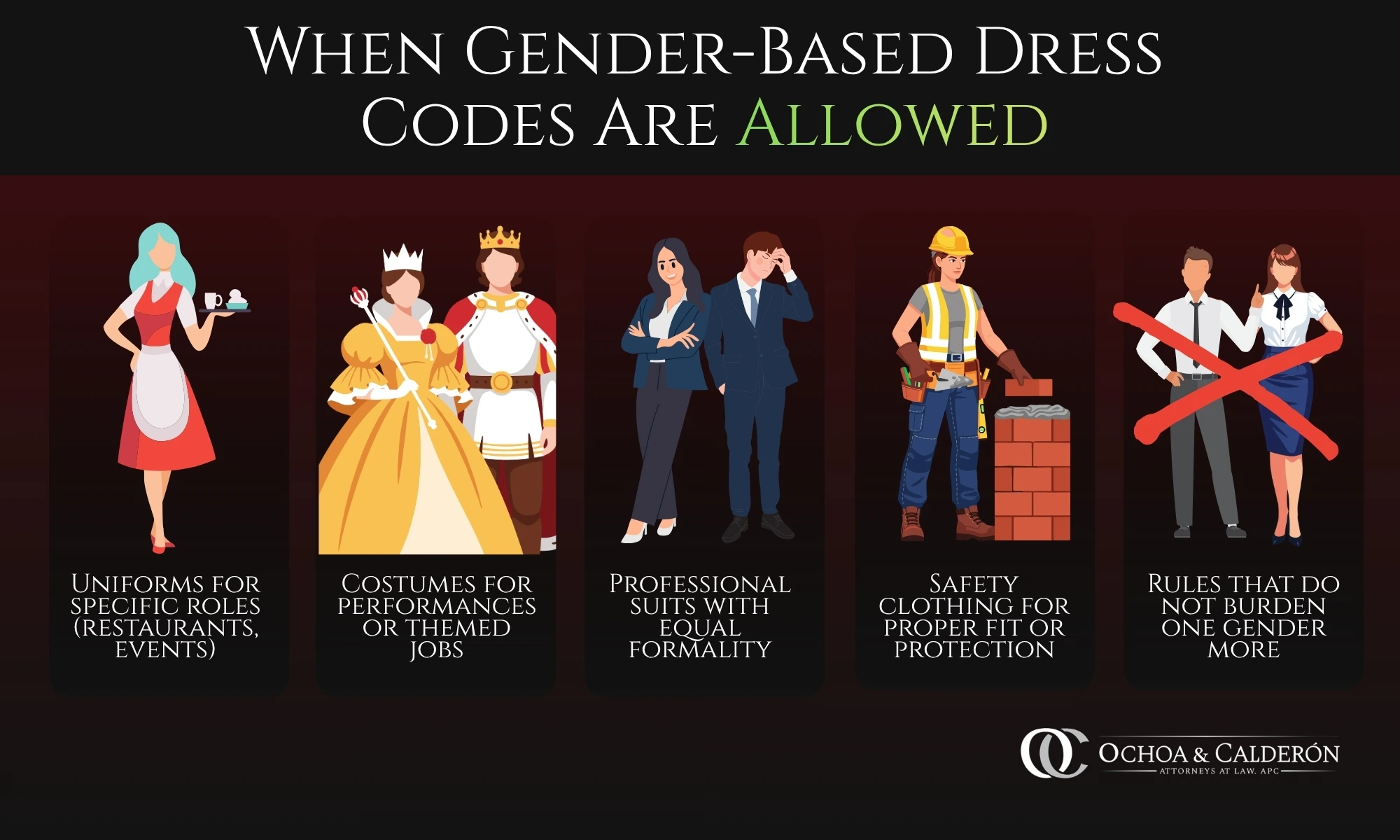
Not every dress code that distinguishes between genders is automatically illegal. California and federal law recognize that, in limited, specific situations, employers may adopt gender-differentiated appearance standards without engaging in unlawful discrimination.
Under both FEHA and Title VII of the Civil Rights Act of 1964, courts have allowed gender-specific dress code policies when the overall burden of compliance is substantially equal, and the rules serve a legitimate business purpose.
Examples where gender-based distinctions have been upheld include:
- Uniformed or themed environments, such as theatrical productions, hospitality venues, or performance-based roles, where attire is part of a defined role or presentation;
- Formal business settings that impose structured but comparable standards (for example, suit requirements that differ in style but not burden);
- Safety-related roles, where protective gear or equipment must be designed differently to ensure proper fit and effectiveness.
What matters legally is not whether the clothing is identical, but whether the time, cost, discomfort, and restrictions imposed are roughly equivalent. A policy may differentiate in appearance while remaining lawful if it does not disadvantage one gender in practice.
Signs a Workplace Dress Code May Be Discriminatory
Dress code discrimination often shows up through enforcement, not policy language.
Common signs include:
- One gender is disciplined more often for their appearance;
- Different standards for similar roles or duties;
- Rules that affect comfort, safety, or movement for only one group;
- Requirements tied to gender stereotypes;
- Vague “professionalism” rules that are enforced selectively;
- Complaints dismissed or ignored by management.
When these patterns emerge, a dress code may cross the line into unlawful workplace discrimination under California law.
How Courts Decide Whether a Dress Code Is Discriminatory
In litigation, courts focus on practical impact, not policy labels. A dress code may include gender-based distinctions and still survive legal scrutiny if the employer proves that the overall burden of compliance is substantially equal and tied to a legitimate business reason.
Judges evaluating these cases consider factors such as:
- Whether one group must spend more money or time to comply;
- Whether the policy causes physical discomfort or health risks;
- Whether enforcement disproportionately targets one gender;
- Whether the rules reinforce gender stereotypes rather than job-related needs.
When courts find that a dress code creates unequal working conditions, employers may face liability for sex or gender discrimination. Potential consequences include back pay, front pay, compensatory damages for emotional distress, policy changes, civil penalties, and attorneys’ fees and costs.
When employers dismiss or downplay these concerns, the issue often escalates beyond dress code enforcement into broader discrimination violations.
Hair, Makeup, and Appearance Rules vs. Clothing Requirements in California
Not all dress code rules are treated the same under the law. Courts often separate what employees wear from how employees are expected to look because these rules impose different burdens and legal risks.
- Clothing requirements include items employees wear for work — such as uniforms, suits, skirts, or shoes. Courts focus on whether these rules cause unequal physical discomfort, limit movement, or impose different costs on one gender.
- Grooming standards regulate ongoing appearance expectations, including hair length, makeup, jewelry, facial hair, and nail requirements. These rules are closely scrutinized because they often reinforce gender stereotypes or require daily time and maintenance that fall more heavily on women.
Courts are more likely to find dress code discrimination in the workplace when grooming rules demand constant upkeep, enforce traditional gender roles, or disproportionately affect certain employees.
Dress Codes Must Respect Gender Identity
Under FEHA, employees have the right to dress in accordance with their gender identity and gender expression. Employers may not force employees to follow appearance standards tied to a sex assigned at birth.
Requiring an employee to wear a uniform or follow grooming rules that conflict with their gender identity can constitute workplace dress code discrimination, even if the policy is enforced consistently across the workforce.
The Evidence That Matters in a Dress Code Discrimination Claim
Courts evaluating dress code discrimination at work rely on practical, objective evidence rather than intent alone.
Key evidence often includes:
- Written dress code and grooming policies
- Emails or messages enforcing appearance standards
- Disciplinary records linked to dress or grooming
- Side-by-side comparisons showing unequal enforcement
- Proof of added cost, time, or physical discomfort
- Witness statements confirming disparate treatment
Patterns of enforcement, consistency of discipline, and real-world impact typically matter more than isolated incidents.
When to Escalate a Dress Code Issue Beyond HR
Employees are usually expected to raise concerns internally first. However, escalation may be appropriate when:
- HR dismisses concerns without investigation.
- Unequal enforcement continues after complaints.
- Retaliation follows a report.
- The policy affects job security, pay, or advancement.
At that stage, speaking with an experienced employment attorney or filing a complaint with the California Civil Rights Department may be necessary to preserve legal rights and avoid missed deadlines.
Don’t Let Dress Code Bias Go Unchecked
We help employees document discrimination and decide when it’s time to take the next step.
We’ll Fight for What’s Rightfully Yours
Don't let them minimize your pain or your claim. We fight for maximum compensation. Get a free consultation today.
Your Next Steps If You’re Facing Dress Code Discrimination
If your employer’s appearance policy limits your comfort, expression, or opportunity based on gender, you may be experiencing unlawful dress code discrimination in the workplace. These cases are highly fact-specific, and early legal guidance can make a meaningful difference.
Ochoa & Calderón represent employees throughout California in sex and gender discrimination matters, including workplace dress code disputes. Our team is ready to review your situation and help you understand your legal options. Contact us today for a free consultation.

Co-Founder & Partner
Co-founder bringing elite education from Pacific Union College and Chapman Law to every case.
Heading
Don't let them minimize your pain or your claim. We fight for maximum compensation. Get a free consultation today.