Many workers still suffering from injuries in California think their workers' comp case is "closed" and assume they have no options left, despite still experiencing symptoms. But under California’s workers' compensation rules, what you think is "closed" may not be completely closed, and understanding this difference is critical to protecting your rights.
If you’ve been injured on the job in Southern California and are having difficulty obtaining the benefits to which you are entitled, contact Ochoa & Calderón for help from a team of experienced and successful Riverside workers’ comp attorneys.
Understanding "Closed" Workers' Comp Cases: The Legal Reality in California
Before we discuss your options, let's clarify what "closed" actually means under California workers' compensation law, because this misunderstanding prevents many injured workers from getting the help they need and receiving full payment.
When Is a Workers' Comp Case Legally Closed in California
Under California law, a workers' compensation case is only truly "closed" in specific legal circumstances:
- Compromise & Release (C&R) signed: You settled your entire case, closing both disability benefits and future medical treatment. This is a complete closure that you voluntarily agree to.
- Stipulations with Request for Award approved: Permanent disability was resolved, though medical treatment may remain open or closed depending on the agreement.
- Final adjudication by a judge: A Workers' Compensation Appeals Board judge issued a final decision resolving all aspects of your claim.
- Statute of limitations expired: Generally, 5 years from the injury date, though exceptions exist.
When Workers Think Their Case Is "Closed" (But It's Not)

Most workers who contact us, believing their case is "closed," fall into very different situations:
- You stopped going to medical appointments: Ceasing treatment doesn't legally close your case.
- You stopped hearing from the insurance company: Silence doesn't equal closure.
- You gave up fighting the system: Frustration led you to stop pursuing benefits, but no formal settlement was signed.
- You represented yourself and became overwhelmed: The complexity of workers' comp drove you to abandon your claim.
- You returned to work: Continued employment doesn't automatically close your workers' comp case.
- You received some benefits and assumed that was everything: Partial payments don't mean your case is resolved.
If you fall into this second category, where you informally stopped pursuing your claim but never formally settled, your case may still be legally active, and you likely have options.
Why This Legal Distinction Matters
Insurance companies benefit from your confusion. When you believe your case is "closed" and stop pursuing benefits, they save money, even if you're legally entitled to continued care and compensation.
At Ochoa & Calderón, we help injured workers understand their true legal position and fight for the benefits California law provides.
Why You Might Still Experience Pain After Stopping Treatment
Even if you stopped pursuing your workers' compensation case, lingering pain can persist for several reasons. Your condition may have worsened, or new symptoms may appear. Sometimes, initial treatments don't fully address the injury. If your symptoms persist, taking action can help you find the right path.
Your Options for Compensation for Pain After You Stopped Pursuing Your Workers' Comp Case
If you're still dealing with pain after you stopped pursuing your workers' comp case, you don’t have to face it alone. There are options that may allow you to seek additional help or compensation. Let’s explore those options.
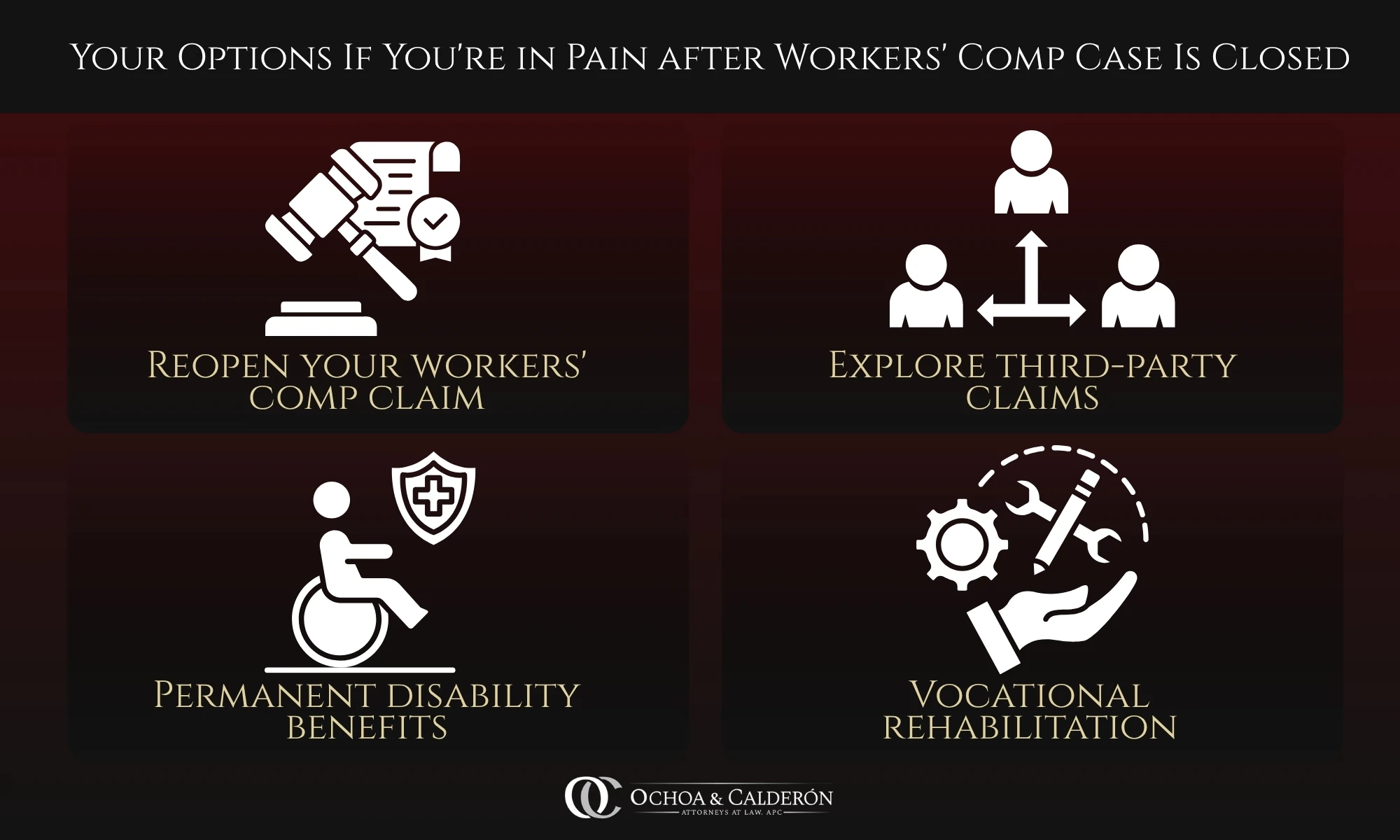
Resume Your Workers' Comp Claim with Legal Representation
If you never signed a settlement agreement and simply stopped treatment, your workers' compensation claim may still be active. With proper legal representation, you can:
- Request authorization for the medical treatment you still need.
- Document how your condition hasn't improved or has worsened since you stopped treatment.
- Challenge previously denied treatment requests.
- Pursue temporary or permanent disability benefits you never received.
Medical records showing ongoing symptoms, new diagnostic tests, and physician statements about continued impairment all strengthen your position when resuming your claim.
Explore Third-Party Claims
If a third party caused your injury, such as a contractor, another worker, or a work-related auto accident, you could pursue a third-party personal injury lawsuit. Unlike workers' comp, a third-party lawsuit allows you to seek compensation for pain and suffering, which workers' compensation doesn’t typically provide.
A third-party lawsuit can offer you compensation that you could not receive in your workers’ comp case, including:
- Pain and suffering: Compensation for emotional distress, physical pain, and loss of quality of life.
- Future medical expenses: Compensation for medical care that you may need in the future.
- Lost wages: If your injury has affected your ability to work, you may be able to recover lost income.
This type of claim is possible if your injury was caused by a third party's negligence.
Permanent Disability Benefits

If your injury has resulted in permanent disability, you may qualify for permanent disability benefits. These benefits are meant to replace lost wages and assist with long-term medical care if you cannot return to work in the same capacity.
These benefits offer:
- Income replacement: These benefits replace a portion of your lost wages due to the injury.
- Ongoing medical care: Assistance with the cost of medical treatments required for long-term care.
While they do not address pain directly, permanent disability benefits provide much-needed financial assistance.
Vocational Rehabilitation
If your injury prevents you from returning to your previous job, vocational rehabilitation may help you transition to a new career. Vocational rehab provides:
- Job retraining: Programs designed to teach new skills suited to your current abilities.
- Career counseling: Guidance on finding new employment opportunities based on your qualifications.
This option helps workers find new career paths if their injury prevents them from continuing in their previous role.
What to Do Right After Realizing the Pain Is Ongoing
If you’re still in pain after your workers' comp case closed, here are some steps you can take:
- Don't assume it's too late: Many workers believe they've lost all rights when they stop treatment, but if you never formally settled, your claim may still be active.
- Consult your doctor: Schedule a follow-up appointment to reassess your condition and get updated medical records.
- Contact an attorney: Our experienced workers' compensation lawyers can assess whether your claim can be resumed and what legal options you have.
- Gather medical evidence: Ensure you have all necessary medical documentation, including test results and new diagnoses.
- Don't sign anything without legal review: Insurance companies may contact you with settlement offers or documents to sign. Never sign anything without first consulting with an attorney because you could unknowingly waive important rights.
- Act quickly: Even if you believe significant time has passed, California's statute of limitations may still allow you to pursue benefits. Consulting with us now preserves your options.
What Workers' Comp Actually Covers in CA
Workers' compensation is designed to help workers recover after a job-related injury. Although it doesn’t cover pain and suffering, workers' comp provides essential benefits to help injured workers get back on their feet. Here’s what workers’ comp typically covers:
- Medical expenses: Workers’ comp covers the cost of medical treatments related to your injury, including doctor’s visits, surgeries, hospital stays, medications, physical therapy, and other necessary treatments.
- Lost wages: If your injury prevents you from working, workers' comp provides compensation for a portion of your lost wages. This benefit is often based on your pre-injury salary and the severity of your injury.
- Temporary disability benefits: If you are temporarily unable to work due to your injury, workers’ comp provides benefits to replace lost income during your recovery period. These benefits typically last until you can return to work.
- Permanent disability benefits: If your injury leads to permanent impairment, workers' comp may provide benefits that compensate for the long-term impact of your injury. These benefits help replace a portion of your lost income and support ongoing medical care.
- Vocational rehabilitation: If your injury prevents you from returning to your previous job, vocational rehabilitation services may be available. These services help you retrain for a different job that accommodates your physical limitations.
While workers’ compensation provides critical support for workers injured on the job, it does have limitations. If you are dealing with pain or suffering that isn’t covered, or if your injuries are more severe than workers’ comp benefits can handle, other legal options may be available to you.
Maximize Your Recovery Potential
If your condition is worsening, it’s time to act. Contact us for a free consultation to explore all possible legal avenues.
We’ll Fight for What’s Rightfully Yours
Don't let them minimize your pain or your claim. We fight for maximum compensation. Get a free consultation today.
Next Steps to Protect Your Rights
If you stopped treatment but are still dealing with pain, don't hesitate to seek help. Our expert workers' comp attorneys at Ochoa & Calderón can explain your options for resuming your claim, pursuing third-party claims, or seeking permanent disability benefits.
Contact us today for a free consultation.

Co-Founder & Partner
Co-founder bringing elite education from Pacific Union College and Chapman Law to every case.
Heading
Don't let them minimize your pain or your claim. We fight for maximum compensation. Get a free consultation today.